Category archive

Indices

Stock index trading (ES, NQ, etc.)

20 stories loaded

Equities
Investing.com — Stock Market · yesterday

European shares slide as Apple margin warning trigger global tech rout

Apple's profit-margin guidance disappointed the market, triggering a cascade of selling across the tech sector in Europe and globally. This suggests either demand weakness or cost pressures in the world's largest publicly traded company—a bellwether for consumer spending and corporate health. Traders are likely reassessing tech valuations and risk positioning across indices and individual names.

Macro
ForexLive · 5 days ago

Week ahead: Elections, rate decisions and jobs take center stage

Next week combines three major drivers: expected 25bp hikes from RBA and BOE (Monday and Thursday), US congressional elections on Tuesday that will shape fiscal policy direction, and dual employment reports Friday from the US and Canada. The core macro question is whether growth, inflation, and labour data warrant further tightening or signal policy is nearing terminal rates; traders should watch guidance tone alongside decision outcomes, election implications for Treasury yields and energy/healthcare sectors, and payroll beats/misses plus wage acceleration clues to recalibrate growth and inflation narratives.

Macro
ForexLive · 5 days ago

investingLive Asia-Pacific market news: Binance hack shakes crypto

Asian equities sold off sharply Friday, with South Korea's KOSPI dropping 4.9% after disappointing Q3 guidance from Amazon and Intel sparked fresh AI cost concerns. The Nikkei fell 2.5%, while a suspected Binance hack—with estimates ranging $2–$3B in outflows—rattled crypto markets, triggering stablecoin freezes and a BNB drop of 8.6%. Simultaneously, the BoJ held rates unchanged at 1.25% but signalled confidence that core inflation is now consistent with its 2% target, lifting forecasts for FY2027 and doubling planned ETF sales from January 2027; US Treasuries rallied to a one-month low on the tech selloff's flight-to-safety bid.

Macro
ForexLive · last week

Australia trimmed mean CPI rises to 3.7%, above forecasts, as RBA hike case firms

Australia's core inflation (trimmed mean) accelerated to 3.7% y/y in Q3, exceeding RBA expectations of stabilization at 3.6%, while headline CPI jumped to 4.3% in September. RBA Governor Bullock confirmed inflation is tracking above August forecasts due to energy shocks and a tighter labor market, cementing market pricing for a rate hike at next week's November 2-3 meeting and supporting AUD and front-end yields.

Macro
ZeroHedge · 2 weeks ago

Futures Rise As SpaceX Blowout Revives AI Trade; Brent Back Above $110

US equity futures opened higher following strong after-hours results from SpaceX ($14.6B revenue beat) and Super Micro's upbeat Q1 guidance, reigniting the battered AI sector after days of selling. The S&P 500 gained 0.3% with 403 advancers (most since April) as rotation into value continued. Oil rebounded sharply—WTI +1.4% to $99, Brent +1.2% to $110—driven by fresh shipping attacks in the Strait of Hormuz and larger-than-expected US crude inventory drawdown (-4.9M vs -1.1M expected), offsetting earlier relief from Middle East peace rumors. French 10Y yields hit 5% (highest since 2002) on persistent fiscal concerns and higher energy costs.

Macro
ZeroHedge · 2 weeks ago

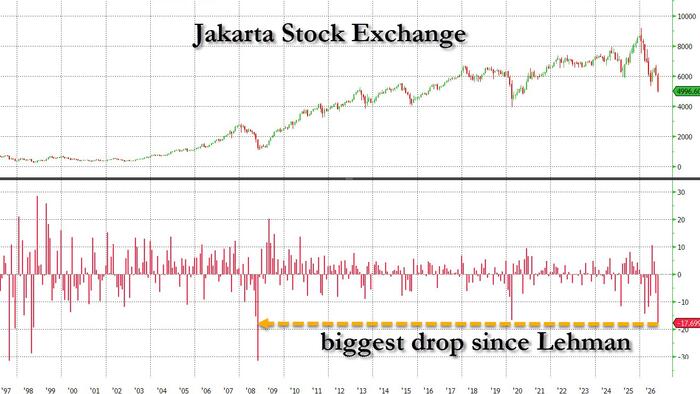
Too Broken For Frontier: Indonesian Markets Suffer Worst Rout Since 1998 As MSCI Threatens The "Argentina Treatment"

MSCI announced Indonesia may be reclassified directly from Emerging Market to Standalone status—skipping Frontier entirely—citing persistent market manipulation, opaque ownership structures, and weak enforcement despite nine months of reform efforts. The Jakarta Composite has fallen 42% YTD with a combined 15% two-day drop, foreign investors are staging a full exit ($5.1B net outflow in 2026), and stress is spreading to bonds and the rupiah (now near 18,000 per dollar). Goldman estimates potential passive outflows of $5.6–8B if MSCI proceeds with removal by August 2027, with the real risk shifting to a self-reinforcing feedback loop across equities, FX, and rates as BI faces a choice between defending the currency and supporting growth.

Macro
ZeroHedge · 2 weeks ago

AI CapEx And Earnings: What Happens When Growth Slows

Goldman Sachs estimates AI capex contributed nearly half of 2026 S&P 500 earnings growth, with hyperscaler spending projected at $800B (2026), $1.2T (2027), and $1.4T (2028). The critical insight: supplier profits depend on year-over-year growth rates, not spending totals—if capex merely holds flat in 2027 instead of rising, implied S&P 500 earnings growth falls to ~1% from 11%. The cycle has three stages (rising/flat/falling spending), and the market currently prices in sustained acceleration that may not materialize as growth rates decelerate from 94% to 50% to 17% over three years.

Macro
ForexLive · 2 weeks ago

China Q3 GDP beats forecasts at 4.5%, retail sales grow at fastest pace since March

China's Q3 GDP came in at 4.5%, beating the 4.4% forecast and hitting the bottom of Beijing's target range, with retail sales jumping to 1.1% (fastest since March) and industrial output at 5.5%. However, the economy shows a two-speed split: factories and exports thrive on AI-related tech demand, while property investment plunged 20.6% and fixed asset investment remains deeply negative at -7.2%. The beat reduces pressure for aggressive stimulus, likely capping expectations for rate cuts at Tuesday's LPR decision and creating mixed signals across Chinese equities, commodities (oil supported by demand, metals/iron ore pressured by construction weakness), and AUD/NZD.

Macro
ForexLive · 2 weeks ago

China data preview: industry holds up, consumers and property lag ahead of Q3 GDP

China releases Q3 GDP and September activity data (02:00 GMT Monday), with consensus expecting 4.4% annual growth—above Q2's 4.3% but below the 4.5–5.0% official target. Exports driven by AI-related demand remain robust and record-setting, but retail sales (under 1%), property investment (−7.5% YTD), and rising crude costs from Iran supply disruption weigh heavily; a miss could trigger immediate policy easing expectations ahead of Tuesday's loan prime rate decision.

Macro
CNBC — Markets · 3 weeks ago

Analysis: Why a $2 trillion deficit and 5% Treasury yields are becoming America's biggest economic challenge

The U.S. 10-year Treasury yield has climbed 114 basis points since late February to 5.1%, driven by geopolitical tension (Iran war), oil price pressure, and massive federal debt issuance competing with corporate AI infrastructure spending. The fiscal 2026 deficit reached $1.99 trillion (6.2% of GDP, up 12% YoY), and with mortgage rates near 7.5%, housing demand is cooling (pending home sales fell 4% in September). Without credible deficit reduction—unlikely given divided government post-midterms—higher rates create a vicious cycle: elevated yields increase the government's debt servicing costs, making deficit reduction even harder, and every 50bp rate overshoot adds ~$1.9T to cumulative deficits over 10 years.

Macro
Investing.com — Overview · 3 weeks ago

CPI Hotter than Expected in September, Up 0.65 Percent

September CPI came in hotter than forecast at 0.65% month-over-month, indicating inflation remains sticky despite Fed tightening. This data point typically triggers a reassessment of rate-cut expectations and can pressure equities while supporting the USD and Treasury yields. Traders should monitor how markets reprice terminal rate expectations and whether this shifts the Fed's forward guidance narrative.

Macro
Investing.com — Overview · 3 weeks ago

Hot US CPI Revives Fed Hike Bets as Stocks and Gold Slip

A hotter-than-anticipated US CPI reading has triggered a repricing of Federal Reserve rate expectations, with markets now pricing in a higher probability of rate hikes rather than cuts. This shift has weakened both equities and gold—traditional beneficiaries of lower-rate environments. The move reflects a fundamental repricing of terminal rate assumptions and suggests traders are rotating out of risk assets into higher-yielding alternatives.

Macro
ForexLive · 3 weeks ago

investingLive Asia-Pacific market news: Treasury rally sinks dollar, lifts gold

US Treasury yields retreated from post-CPI highs during Asian trading, with 10-year yields down 21 basis points, sparking a broad dollar weakness and gold rally of roughly $40/oz. The move was supported by speculation that China holds more US debt than officially reported (possibly via Canadian custodians) and comments from Fed officials signaling no October rate move despite likely future hikes. Asian equity indices fell sharply—Japan's Nikkei dropped 5% and South Korea's Kospi near 8%—as tech hardware stocks tracked Wall Street losses amid AI financing concerns and rate-hike anxiety.

Macro
CNBC — Markets · 3 weeks ago

IMF warns bond yields could see a 'disorderly' spike as debt, inflation risks worsen

The IMF's Global Financial Stability Report flagged deteriorating risks in government bond markets, citing record global debt (near 100% of GDP), competing AI-firm borrowing (now 10% of investment-grade issuance), and concentrated hedge-fund positions in Treasuries (9% share, up from 4% in 2022). A sharp, disorderly yield spike could mark down collateral values, erode asset valuations across risk assets, and potentially trigger a forced unwind of leveraged Treasury trades, particularly if overlapping hedge-fund positions unwind simultaneously.

Macro
ZeroHedge · last month

US Manufacturing Survey Strongest Since May 2022 On AI Spend, Prices Paid Spike

September's ISM manufacturing PMI (54.5) and S&P Global surveys both hit multi-year highs driven by AI-related capex and machinery investment, with new orders surging and factories lifting output and hiring. However, prices paid spiked sharply, order backlogs are rising, and capacity is stretched—signaling inflation pressures remain despite persistent weakness in export orders. The data combination (strong growth + elevated pricing + tight labor market) triggered a rally in 10Y yields as markets price a more hawkish Fed than labor-market weakness might otherwise suggest.

Macro
ZeroHedge · last month

Futures Rise As 10Y Yields Pull Back From 24 Year High

U.S. equity futures opened Q4 higher despite a significant bond selloff, with 10-year Treasury yields reaching 5.34%—the highest since 2002—before retracing slightly to 5.27%. The S&P 500 futures rose 0.4% and Nasdaq 100 gained 0.7%, driven by semiconductor and mega-cap tech strength following Micron's upbeat earnings and guidance on AI-driven memory demand. The disconnect reflects a market rotation into AI-beneficiary stocks while broader sectors and small caps (Russell 2000) struggle under elevated rates; JPMorgan's strategists flag that bonds appear oversold but lack a clear support level, with BNP Paribas identifying 5.5% on the 10Y as a critical pressure point for equity valuations. Oil climbed 2%+ amid U.S.-Iran negotiation stalls and geopolitical risk, while the dollar set a 52-week high.

Macro
MarketWatch — Bulletins · last month

Yields on the 10-year and 30-year Treasurys reach highs not seen since 2002

Long-dated U.S. Treasury yields have risen to their highest points in over two decades, with both the 10-year and 30-year reaching 2002 peaks. This repricing reflects sustained inflation concerns, Fed policy expectations, and a broader rotation out of bonds into equities and risk assets. The move has significant implications for equity multiples, mortgage rates, and currency positioning—particularly the USD strength it may reinforce.

Macro
Investing.com — Economy · last month

US inflation rises less than expected in August; consumer spending surges

August CPI came in below consensus, signaling moderating price pressures even as consumer spending accelerated—a potentially bullish setup for risk assets and a softer landing narrative. This mixed signal (cooling inflation + robust demand) typically supports equities and pressures USD if the market interprets it as runway for the Fed to cut rates without economic deterioration.

Macro
ZeroHedge · last month

Core PCE Prints Cooler Than Expected Due To Change In Methodology, As Savings Rate Plunges To 3 Year Low

Core PCE printed 3.0% YoY (vs. 3.3% expected) and 0.2% MoM (vs. 0.3% expected), but the miss is largely attributable to a Bureau of Economic Analysis methodology update rather than genuine disinflation. Simultaneously, August consumer spending surged 0.9% MoM while income growth collapsed to just 0.2% MoM, forcing households to draw down savings to a Nov 2022 low of 4.1%. The data presents a mixed signal: softer nominal inflation on the print, but underlying consumer stress and energy headwinds not yet reflected in the August snapshot.

Macro
Investing.com — Economy · last month

Fed rate hike bets for Oct fall sharply on soft data, dovish comments

Market rate-hike probabilities for October have dropped sharply following weaker-than-expected economic data and dovish commentary from Federal Reserve officials. This shift reflects growing expectations for a pause or potential rate cut, which typically supports risk assets and weakens the dollar. Traders should monitor upcoming employment and inflation prints, as near-term Fed messaging will likely drive volatility in equities, bonds, and FX.