
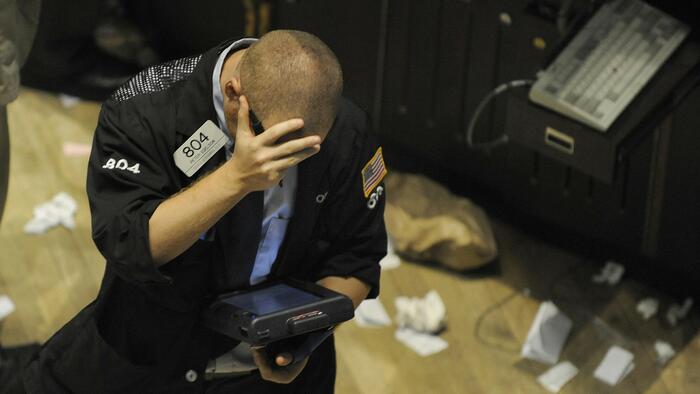
US futures are sliding, dragged by fears of a possible AI development slowdown as well as higher oil prices (Brent > 108), though bond yields are not reacting yet (10Y yield still under 5%). As of 8:00am ET, S&P futures are down 0.6%, and potentially facing their first down 1% day since late July; Nasdaq futures plunging 1.
5% as AI-linked stocks like chipmakers and memory tumble in US premarket trading following a call to put the brakes on developing cutting-edge models. Semis are down 4.7% pre-mkt, driven by the AI pullback story though China is pushing back saying the statements are alarmist; expect additional pushback from Trump.
Software is +1.5% but Mag7 are weaker with NVDA -3.2%, TSLA -2.
1%, and META -1.2%. Staples / HC are bid with Discretionary / Fins mixed but slightly positive.
Industrials are also getting hit with AI theme (less data center contruction). Brent is rising and sitting close to $108/barrel on the shutdown of a Saudi pipeline and as a meeting between Iran and Gulf nations was delayed. That’s weighing on European bonds, mostly at the short-end.
UK two-year yields are up six basis points, German two-year yields by five basis points. Treasuries are little changed at the short-end, while 10-year yields are down a basis point. The USD is seeing its strongest day in 3 wks, rallying with oil and the Bloomberg Dollar Spot Index is up by 0.
4%, with the New Zealand dollar and Japanese yen among the underperformers. Gold prices are sinking and now below $4,300/oz. Commodities are mostly lower ex-Energy with WTI approaching $104/bbl with fuel prices higher; moves are driven by Saudi closing east/est pipeline and a delay on Iran/Gulf countries meetings to discuss Strait of Hormuz navigation.
Base metals are outperforming Precious, but both are lower. US economic data slate empty for the session. Fed speakers remain in external communications blackout period ahead of Sept.
15-16 FOMC meetingIn premarket trading, Mag 7 stocks are mixed: Nvidia (NVDA) falls 2.3% as AI leaders called for a slower pace of development of their most advanced and lucrative models (Alphabet +1.8%, Amazon -0.
4%, Apple +0.5%, Meta +2.6%, Microsoft +0.
3%, Tesla -1.5%)Chipmakers and other artificial intelligence-related firms slide. Decliners include Intel (INTC) -6%, Micron (MU) -5% and CoreWeave (CRWV) -7%.
Baldwin Insurance (BWIN) gains 6% after the Financial Times reported that billionaire Michael Dell’s family office is nearing a deal to acquire the insurance brokerage firm.Corning (GLW) falls 9% after entering into a $2 billion equity distribution agreement with Goldman Sachs.Definium Therapeutics (DFTX) rises 16% after the company announced that its Phase 3 Panorama study met its primary and key secondary efficacy endpoints.
Hewlett Packard Enterprise (HPE) falls 7% after Evercore ISI downgraded the company to inline from outperform, citing valuation in the wake of recent strength.Olema Pharmaceuticals (OLMA) falls 9% after AstraZeneca’s Etcamah failed to meet the primary endpoint of progression-free survival in a late-stage trial in first-line advanced breast cancer.Rum Group (RUM) rallies 11% after the Information reported that Anthropic has struck a $13.
7 billion compute pact with the firm.Scholar Rock (SRRK) rises 6% after the drug developer said the US FDA has approved its muscle-targeted therapy for spinal muscular atrophy. Analysts are positive about the approval, with many raising their price targets ahead of the drug launch.
In other corporate news, Anthropic was said to pick Nasdaq for a potential listing. It also told investors it expects a second straight quarter of positive adjusted operating profit, according to the FT. OpenAI will not go public in 2026, Sam Altman told Fortune Magazine in an interview, citing need for safety-related work.
Kalshi is filing for regulatory approval to offer the first single-stock perpetual futures in the US and is looking to expand the contracts in commodities to include agriculture. In deals, Apollo is in discussions to acquire Johnson & Johnson’s orthopedics unit for $20 billion, according to people familiar with the matter. Billionaire Michael Dell’s family office is nearing a deal to acquire The Baldwin Insurance Group, an insurance brokerage with a market value of $4.
2 billion.Stock futures slide, led by tech names after leaders of the biggest artificial-intelligence firms proposed slowing the technology’s development. An ETF tracking key chip stocks dropped 5% in early trading as traders fretted that efforts to rein in AI could weigh on the boom driving hundreds of billions of dollars in capital spending.
OpenAI backer SoftBank slid the most in nearly three months, while South Korea’s Kospi index dropped 3.3%. S&P 500 contracts were down 0.
6%. “There was a bit of irrational exuberance in the middle of the summer that’s been unwound,” said Chris Armstrong at Berenberg. “This is, I think, another leg bringing down expectations.
”Anthropic CEO Dario Amodei sparked the rout after saying on Saturday that the company would introduce fresh safeguards as he urged the industry to slow the development of its most advanced models. OpenAI’s Sam Altman backed the proposal, while xAI’s Elon Musk said “Dario is right.”Questions remain over how committed AI leaders will be to moderate the pace of development, given intense competition from China.
President Donald Trump downplayed the concerns, while China dismissed them as “fearmongering.”“Having guardrails would help steer the direction of AI development, but we do not think it is going to slow it down,” noted Mohit Kumar at Jefferies. “The direction of travel, in our view, would still remain forward.
”Nevertheless, tech - the biggest weighting in the S&P 500 - is facing pressure on both sides of the valuation equation: Tighter financial conditions are pushing up the discount rate, while Amodei’s intervention puts fresh scrutiny on the growth assumptions underpinning the AI trade.Fresh disruptions to crude supplies from the Middle East added to the dour mood. Brent jumped 3.
7% to top $108 a barrel after Saudi Arabia closed its East-West pipeline as a precaution following attacks. The dollar rose 0.3% while treasuries slipped as money markets saw a nearly 90% chance of a Federal Reserve rate increase on Wednesday.
Gold tumbled. “Two unwelcome headwinds collide,” said Tim Waterer, chief market analyst for KCM Trade. “Warnings that AI development needs to slow down, combined with another leg higher in oil prices after the Saudi East-West pipeline closure, are a difficult mix for risk assets.
”The selloff in tech stocks comes at the start of a week in which both the Fed and Bank of Japan face pressure to raise rates as policymakers meet Wednesday and Friday, respectively, against a backdrop of mounting inflation risks. Traders are pricing a 90% chance of a 25-basis-point Fed hike this week. Most strategists aren’t too worried, with those at banks including Morgan Stanley, JPMorgan and Goldman Sachs saying any declines driven by expected tightening are likely to be short-lived given healthy earnings.
While a Bank of England hike on Thursday isn’t anticipated, the prospect of a shift toward an increase in November remains on the cards. “We will take each decision when it is needed, and we will not waver when the evidence calls for action,” Kazimir said Monday in an op-ed on the website of Slovakia’s central bank, which he heads.Europe’s Stoxx 600 dipped 0.
3%. The region’s bonds underperformed as higher oil and gas prices worsened the inflation outlook. Yields on two-year UK gilts rose eight basis points to 4.
89%. The euro hit a one-month low against the dollar. Here are the biggest movers Monday:Campari shares rose as much as 4.
5%, the most in six weeks, after Morgan Stanley upgraded the stock to overweight, noting the beverage maker’s strategy is yielding results and that a cash-flow inflection is potentially on the horizonAxfood climbed as much as 4.3%, the most since January, as Hand