
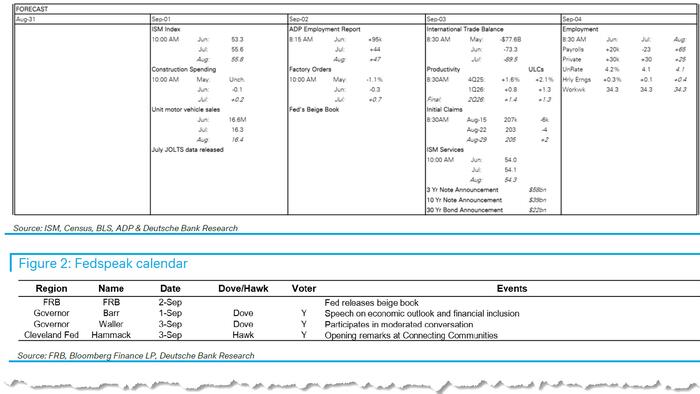
Following on the heels of Warsh’s speech at Jackson Hole last Friday, which was hawkish yet which also sent yields to multi-year highs thus refuting claims the Fed Chair regained some credibility, the data docket picks up this week with the main event being Friday’s August employment report. Regarding Warsh, he delivered a crisp message to market participants last Friday that resolved much of the confusion from his July post-meeting press conference. Indeed, Warsh went one step further and provided his own views on recent data trends.
On inflation Warsh stated, “And while this summer's PCE and CPI readings were better than expected, they do not tell me that underlying trends have meaningfully improved.” It will be interesting to see if Governor Waller reinforces this message when he takes part in a moderated discussion on inflation this Thursday at Reuter’s Next conference.On the labor market, Warsh noted that “When labor supply is barely growing, monthly job gains are naturally going to run low.
There are always areas of concern in the labor market—for example, among recent graduates. In general, though, people who want to work, by and large, are holding or finding jobs. They may well be concerned about possible future labor disruptions, but as of now, I believe the labor markets are consistent with full employment.
” In short, Warsh delivered a message that was bullish on the economy and hawkish on inflation, reinforcing our longstanding view that the Fed will hike rates at the September 16 FOMC meeting. Market participants will no doubt be trading upcoming data within the context of the views Warsh laid out last Friday. Though economists expect headline nonfarm payrolls to rebound (+65k forecast vs.
-23k previously) due to payback from state and local education hiring, the private payroll forecast is somewhat more muted (+25k vs. +30k). Meanwhile, Bloomberg economists say there is a "decent chance" of a second consecutive negative print...
and the Fed has never hiked after two negative prints. I think next week’s payrolls print will disappoint, and has decent (though not our baseline) chance of being negative. Supposed it is a negative print.
There is no modern Fed era precedent of Fed hiking after two negative payrolls prints. Still 50-50? — Anna Wong (@AnnaEconomist) August 29, 2026That said, with average hourly earnings (+0.
4% vs. +0.1%) also expected to rebound following some unusually soft prints in specific sectors last month, the year-over-year growth rate of the DB payroll proxy for nominal income should remain around 4.
0%. To be sure, Fed officials are likely to focus greater attention on the unemployment rate, which economists expect will remain unchanged at 4.1%, though there is some risk that it rounds up to 4.
2%. However, even if the unemployment rate ticks up a tenth, it is unlikely to result in the Fed reappraising its labor market view, particularly given as Chair Warsh noted “Unemployment claims, on a four-week average—an empirically robust real-time indicator—are near their lowest level in decades.”As DB notes in its weekly preview, there are a few data points ahead of Friday’s employment report print that could on the margin impact sentiment heading into the print.
While Tuesday’s JOLTS data are somewhat dated given that they correspond to July, they will nonetheless provide the latest readings on the hiring, layoffs and quits rates. Broadly speaking, most of these rates are expected to remain unchanged from recent tight ranges – still painting the picture of a “low hiring / low firing” labor market environment that we’ve been accustomed to for the past three years. Wednesday’s ADP private employment survey (+44k exp) should reinforce the picture of a stable labor market, albeit at depressed levels of gains partly due to low labor supply growth that Chair Warsh mentioned.
Our ADP forecast is consistent with the latest reading for their weekly series.Lastly, Tuesday’s manufacturing ISM (55.8 vs.
55.6) and Thursday’s services ISM (54.1 vs.
54.1), while not directly impacting forecasters’ payroll expectations, will nevertheless provide a more forward-looking view from businesses on hiring trends. Note that while the employment component of the manufacturing survey has been trending up over the last three months, the employment component of the services series has been moving in the opposite direction and remains below 50.
In summary, should this week’s labor market data come in close to expectations, it will reinforce monetary policymakers’ view of a stable labor market that is consistent with their maximum employment mandate. As Chair Warsh emphasized “Inflation is running above our 2 percent target. So the Fed's predominant focus right now should be on prices.
” As we noted in our Jackson Hole recap note, the specificity of Warsh’s comments and the uniformity of the color in a hawkish direction, has changed the setup for the September FOMC meeting. As long as incoming data do not surprise meaningfully to do the downside, Warsh’s speech has established a rate hike as the most likely policy outcome next month.Here is a day by day preview courtesy of RabobankMonday: sees German inflation numbers for August, starting with the regional states and followed later that day by the first estimate for the nationwide and harmonised gauge.
Last week, data from France, Belgium and Spain already indicated that the rebound in energy prices would push inflation higher again following its easing trend since May. We expect the same in Germany. In the US, the main figure to watch is the (second-tier) Dallas Fed Manufacturing Activity survey for August.
Tuesday: German retail sales (July), Italian GDP details (Q2) and UK money supply and credit (July) all feature in the morning session, but the key figures to watch are Eurozone headline and core inflation for August. In particular, a renewed rise in core inflation (not our base case, but a possibility) could trigger further rate hike expectations beyond the September meeting. No change in the Eurozone unemployment rate for July would only underscore those risks.
In the US, we have the JOLTS (July) labor-market flows data. Normally not a market mover, it could nevertheless shed more light on the recent slowdown in job growth. Meanwhile, only a small fall in the US ISM manufacturing survey for August (as per the consensus) could be interpreted by the market as a sign that US, as well as global, manufacturing activity is recovering despite ongoing concerns over tensions in the Middle East.
Wednesday: Australia releases its Q2 GDP numbers. Consensus expects quarterly growth to match Q1 at 0.3%.
The Fed also releases its Beige Book, but Wednesday’s key event is likely to be the Bank of Canada’s interest rate decision, which investors may suddenly see in a different light since the eruption of the US-Canadian trade war. There are no signs that negotiations will resume anytime soon.Thursday: Australia releases July trade balance figures, while the US calendar includes the July trade balance and August ISM services survey.
Final S&P Global PMI releases and country extensions are also due, including for Spain and Italy, alongside Eurozone PPI and German factory orders for July.Friday: The US nonfarm payrolls and unemployment figures are the highlight of the day. The street forecasts net job creation of 55,000 in August, following an unexpected dip in July.
Although the jobs report is always a market mover, Fed Chair Warsh’s comments at Jackson Hole suggest the Fed’s focus is now on the near-term path for inflation rather than the labour market. Eurozone retail sales for July are expected to recover from a dip in June, but the underlying trend remains lacklustre as households face slowing real wage growth. The ECB’s Lane speaks in Dublin, but since –by then– the ECB’s pre-rate decision quiet period has commenced, he may not address current policy issues.
Finally, looking at just the US, Goldman writes that the ke