Category archive

Macro

Macro, rates and market structure

20 stories loaded

Macro
ForexLive · 6 hours ago

Australia household spending beats, up 0.8% in June (expected +0.2%, prior +1.3%)

Australian household spending rose 0.8% in June to A$81.3 billion, vastly exceeding the 0.2% consensus forecast and following a 1.2% May gain. The beat was driven by discretionary categories—hospitality, recreation, household goods, and EV purchases—suggesting genuine consumer confidence rather than price-driven necessity spending. With inflation elevated and the labour market holding up, this data strengthens the case for the RBA to extend its tightening cycle, likely supporting AUD strength and upward pressure on rate expectations.

Commodities
ZeroHedge · 18 hours ago

"Really Only One Thing Worries Us A Lot": Here's What Keeps Goldman's Commodities Guru Up At Night

Goldman Sachs' Samantha Dart identified diesel as the most vulnerable oil product heading into winter due to constrained global supplies—Russian refinery outages from Ukrainian strikes, export restrictions, and reduced tanker flows through the Strait of Hormuz. She's recommending a long December/short March diesel calendar spread to exploit the seasonal demand lift against tight supply, and separately shorting European natural gas 2028 contracts on expectations of eventual oversupply. Global refinery runs have hit their lowest seasonal level since COVID, with European gasoil cracks above $70/bbl.

Macro
ForexLive · 18 hours ago

US ISM Manufacturing PMI for July 55.6 versus 54.0 estimate

July ISM Manufacturing PMI expanded to 55.6 from 53.3, the strongest in over four years and above the 54.0 consensus, driven by broad-based gains in production (58.5), new orders (56.7), and employment (52.8 vs. 49.7). The report signals manufacturing momentum is accelerating with rising backlogs and low customer inventories suggesting near-term demand strength, though elevated prices paid (71.1) and supply-chain bottlenecks signal persistent inflationary pressure and potential hawkish implications for Fed policy.

Macro
ZeroHedge · 18 hours ago

Key Events This Week: Jobs, ISMs, Fed Speakers And More Earnings On Deck

This week is data-heavy across macro calendars: the US will release JOLTS, ADP employment, and Friday's crucial July jobs report (consensus +85k nonfarm, +83k private), with risks skewed toward a 4.3% unemployment rate. Fed speakers (Cook, Schmid, Musalem, Barkin) will be closely monitored for rate-path signals following three dissents favoring a hike last week. Globally, investors will watch Swiss/Swedish inflation, German activity data, Chinese PMI and trade figures, and Japanese wage momentum. Concurrent heavy earnings from Palantir, AMD, Disney, Uber, and others.

Commodities
Investing.com — Overview · yesterday

Oil Dips 7% as Trump Calls Off a Planned Attack on Iran

Oil prices dropped sharply on news that Trump called off a planned attack on Iran, reducing geopolitical risk premium that had supported crude. The move signals a de-escalation in Middle East tensions, which had been a key driver of recent oil strength. Traders are now repricing the tail risk of conflict out of the market, likely shifting focus back to supply/demand fundamentals and macro growth concerns.

Forex
Investing.com — Forex · yesterday

Japan may have intervened in FX market by spending $36.58 billion to buy yen

Japan's Ministry of Finance likely conducted a major intervention operation, deploying approximately $36.58 billion to buy yen and defend against weakness. This represents a significant show of force in currency markets and signals policy resolve to prevent further depreciation. The scale and timing matter for USD/JPY positioning and broader risk sentiment, as intervention can create sharp reversals and liquidity disruptions.

Macro
ForexLive · yesterday

Market moving news for Asian trading on 3 August: Oil slumps on Trump's Iran claims

Oil fell sharply as Trump claimed a Hormuz strait deal and cancellation of Iran strikes, though the claim remains unconfirmed and contradicted by reported Iranian missile attacks. USD/JPY plunged below 156 following official confirmation of Friday's coordinated yen-buying intervention by the US Treasury and Japan's MOF, with both officials pledging further action; Japan's Nikkei and Korea's KOSPI sold off on yen strength and chip concerns respectively. China's July manufacturing PMI missed forecasts at 50.9, signalling slower expansion, while OPEC+ agreed to a modest 188k bpd output hike in September.

Forex
ZeroHedge · yesterday

Japan, Bretton Woods 2.0, & The End Of The Carry Era

Japanese and US authorities executed joint yen-buying operations Friday, moving USD/JPY from 157+ (1986 lows) to 157.40 in hours through direct intervention, jawboning, and bank calls. Tokyo plans to announce Monday; US Treasury commitment evidenced by Bessent's $5-10B JPY purchase note. The piece frames this as the unwind of the 40-year yen carry trade and argues that if Japan must liquidate US Treasuries to defend the yen, the long end reprices on capital flows rather than inflation—a structural regime shift with implications for rates, duration, and central-bank policy.

Forex
Investing.com — Economy · 2 days ago

Japan to announce joint yen intervention with US, sources say - Reuters

Japan is preparing to announce coordinated yen intervention alongside the US, signaling an attempt to arrest recent yen weakness or volatility. This type of coordinated G7-style intervention is rare and typically deployed when currency moves are seen as disorderly or economically damaging; the announcement itself often carries more weight than the actual intervention size.

Commodities
ZeroHedge · 3 days ago

Crude Inventories Have Fallen To "Precariously Low" Levels

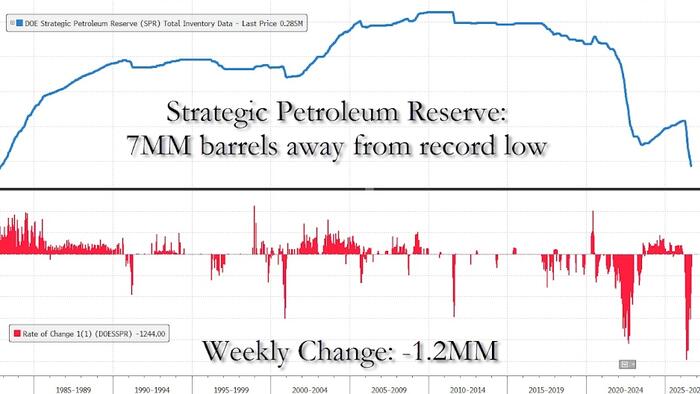
Commercial crude inventories fell 7.2 million barrels and the Strategic Petroleum Reserve dropped 3.8 million as U.S. refineries operated at 97% capacity to capitalize on higher fuel prices amid Iran-related supply disruptions. The SPR has now fallen to 307.7 million barrels—its lowest in over 40 years—while the U.S. accounts for 70% of global onshore crude draws over the past four months. Analysts warn that at current depletion rates, inventory buffers are unsustainable and leave the U.S. increasingly vulnerable to future supply shocks.

Equities
Investing.com — Stock Market · 3 days ago

Apple set to lose nearly $500 billion in value after weak forecast

Apple issued a disappointing forward guidance that triggered a significant selloff, erasing approximately $500 billion in market capitalization. The move reflects either a material miss on revenue/margin expectations or weak demand signals that recalibrate investor sentiment on the mega-cap tech name. This is a key liquidity event for index futures (Nasdaq exposure) and a potential inflection point for growth/tech rotation.

Forex
ZeroHedge · 4 days ago

US Treasury Informed Banks It May Intervene In Japan's Yen, As Market Laughs At BOJ's Own Attempts To Prop Up Currency

The US Treasury notified banks through the New York Fed that it may intervene in USD/JPY on Friday, coordinating with the Bank of Japan's record $140 billion intervention attempt to stem yen weakness. The yen briefly rallied from 163.65 to 159.22 on the intervention signals, but momentum stalled as markets questioned the sustainability of coordinated action. With multiple intervention attempts in 48 hours proving ineffective and the BOJ described as 100+ basis points behind on rate hikes, this signals growing policy coordination risk and elevated volatility potential in the pair.

Indices
ZeroHedge · 4 days ago

Futures Rise After Record Rip In Kospi; Bond Bounce Fades As Oil Jumps, BoJ On Hold

US tech futures extend gains on strong earnings: Amazon's AWS revenue jumped 37% YoY (vs. 31.3% consensus), driving AMZN +12% premarket, while Apple fell 7% on weaker sales guidance citing supply shortages. The Nasdaq 100 futures climbed 1.2% with S&P 500 futures +0.5% as 86% of reported S&P 500 companies beat estimates—the highest 5-year pace. South Korea's Kospi surged a record 18% overnight on SK Hynix strength. Separately, the BoJ held rates at 1% as expected; the yen spiked on suspected coordinated intervention (JPY/USD briefly touched 158.34) before paring back. Oil prices recovered after Iran tanker blockade headlines; bond gains faded. China's manufacturing PMI unexpectedly fell into contraction.

Commodities
ZeroHedge · 4 days ago

Wheat Prices March Higher As Intensifying Black Sea Fighting Fuels Food Security Fears

Wheat futures rose as much as 3.9% on Thursday following intensified Russian strikes on Ukrainian Black Sea ports, with three cargo ships hit in recent days. The UN has flagged the escalation as a serious risk to global food security, warning that further supply disruptions could drive up freight, insurance, and food costs—particularly for import-dependent developing nations. The Bloomberg Agriculture Spot Index has already climbed to a three-year high, signaling that geopolitical risk is pricing into the broader agricultural complex.

Macro
ForexLive · 4 days ago

Euro area inflation nudges up in July, keeps the pressure on the ECB

Eurozone inflation surprised to the upside in July, with both headline CPI (+2.9%) and core CPI (+2.5%) beating expectations. The concern isn't energy alone—services inflation accelerated to 3.3% and monthly rates show broad-based pressure. Market pricing has shifted: September rate-hike odds moved from 64% to 66%, and traders are now pricing ~38 bps of total hikes by year-end with another ~52 bps before mid-2027. This data keeps the ECB under pressure despite hopes for a summer pause.

Macro
CNBC — Markets · 4 days ago

China's factory activity unexpectedly contracts in July on demand slump, typhoons

China's official manufacturing PMI fell unexpectedly to 49.2 in July from 50.3 in June, breaking a four-month expansion streak and marking the weakest reading since February. The contraction was driven by a sharp collapse in new orders (48.5, the lowest in 38 months) and weakening exports as the front-loading surge ahead of U.S. tariffs unwound, compounded by typhoon disruptions. The broad weakness across construction, services, and composite indices signals domestic demand stress, pressuring Beijing to accelerate fiscal stimulus; however, firms' forward expectations remain resilient, suggesting they anticipate policy support to stabilize growth in H2.

Forex
Dow Jones — Markets · 4 days ago

Japanese Yen Jumps to 2-Month High Versus Dollar in Possible Intervention

The yen jumped 3% against the dollar in a single move, likely triggered by Japanese government intervention after officials ramped up rhetoric against speculative weakness in the currency. A 3% move in a major FX pair is substantial and suggests either coordinated intervention or a rapid unwind of carry trades; this matters for risk positioning because it signals the BoJ/MOF is willing to act on inflation concerns tied to yen weakness, which could impact broader JPY pairs and force repositioning in leveraged carry trades.

Macro
ForexLive · 4 days ago

investingLive Americas FX news wrap 30 Jul USDJPY moves sharply lower on speculation of intervention.

Thursday's US economic data painted a mixed picture: Q2 GDP grew just 1.5% versus 2.1% expected, but consumer spending accelerated to 3.2% and the Dallas Fed Trimmed Mean PCE collapsed to 1.4%—the lowest since 2020—signaling faster disinflation beneath headline numbers. Initial jobless claims beat at 197K. The USDJPY collapsed from 163.30 to 158.00 on suspected Japanese intervention, anchoring to the 200-day MA at 157.89, while major indices rallied hard (+1.66% S&P, +3.36% Nasdaq 100) and Treasury yields rose 5–7 bps across the curve, reflecting persistent long-end inflation concerns despite the dovish data.

Macro
CNBC — Markets · 5 days ago

U.S. economy slowed to 1.5% growth rate in Q2; June core inflation at 3.3%

Q2 GDP disappointed at 1.5% vs. 1.8% forecast, but weakness came primarily from inventory drawdowns and lower federal spending—underlying consumer demand remained solid with personal spending up 2.1% and final sales to domestic purchasers up 3.9%. Core PCE inflation held at 3.3% (down from 3.4% quarterly), still 1.3 points above the Fed's 2% target, which intensifies policy uncertainty heading into a period when the Fed may be reluctant to cut rates aggressively despite a softer growth picture.

Macro
ForexLive · 5 days ago

US June PCE inflation 3.7% vs 3.7%% expected. Core 3.3% vs 3.3% expected

June PCE data came in exactly in line with consensus—headline 3.7% YoY (down from 4.1%) and core 3.3% YoY (down from 3.4%)—but the month-over-month prints reveal a sharper disinflationary pulse: core MoM at 0.1% vs 0.2% expected, and services ex-energy at 0.1% vs 0.5% prior. The Fed remains focused on the 2% target, which the article suggests could take 6–8 months to approach if inflation stays tame, but with energy prices as the wild card—any creep in oil could derail the disinflation trajectory and complicate rate-cut timing.