
More than two months ago, long before most Wall Street analysts had any clue that the bulk of the AI buildout commitments were diligently hidden in various off-balance sheet SPVs and other (perfectly legal) accounting gimmicks, we wrote a lengthy article detailing just that, and explaining why far beyond the $1 trillion (and rapidly rising) in annual plain vanilla capex -- all of which now has to be funded through debt issuance since free cash flow across the hyperscaler universe is negative for the foreseeable future (if not forever) -- which most pundits obsess over daily...... the real risk was in the "The $1.8 Trillion Off-Balance Sheet Time Bomb At The Heart Of The AI Supercycle.
"The $1.8 Trillion Off-Balance Sheet Time Bomb At The Heart Of The AI Supercycle https://t.co/2IAxYrTXjL — zerohedge (@zerohedge) June 12, 2026We followed up on this critical topic after the latest batch of hyperscaler earnings in late July, which revealed that the nearly $2 trillion in spending commitments had exploded in the second quarter, with just GOOGL and META north of $1.
5 trillion, which prompted us to conclude that "across all hypers, off BS commitments are now $3+ trillion, double in one quarter."*MICROSOFT: LEASES THAT HADN'T COMMENCED $329.1B AS OF JUNE 30 we will be updating the off balance sheet obligations/debt for Q2 soon.
It will probably rise by $1TN+ to $3TN. — zerohedge (@zerohedge) July 29, 2026The SPV bubble is batshit insane GOOGL is $826BN and now Meta said it has already committed almost $700 billion in future AI spending (BBG). Across all hypers, off BS commitments are now $3+ trillion, double in one quarter.
GLTA https://t.co/HyV9ZGgFu5 — zerohedge (@zerohedge) July 30, 2026Many, traditionally those who had no idea what we were talking about or the implications of the above findings, took the conventional route and either mocked or slighted what we had found. But not everyone: first it was Nvidia which, scrambling to distance itself from the circular financings that were meant to fund precisely these kinds of gargantuan off balance sheet SPVs, unveiled its $500 billion arrangement with a handful of private credit firms (an arrangement that was nothing new, as Nvidia had already done just that particular deal on numerous occasions, and it merely formalized it in the form of an open-ended MOU).
Second and more important, two months after our first warnings, the WSJ finally caught up, and in an article over the weekend titled "Why Big Tech’s AI Spending Is $3 Trillion Higher Than It Seems", it confirmed everything we have been reporting since early June.Not to put too fine a point on it, but WSJ authors Rudegeair and Santilli echoed everything we said in our original report more than two months ago, to wit: Each quarter, big tech companies disclose their massive capital expenditures on artificial-intelligence infrastructure, from data centers to chips. But those figures don’t come close to expressing the full extent of future spending to which Google parent Alphabet, Meta Platforms, Oracle and many others have committed.
That is because a huge swath of their coming financial obligations aren’t reflected on their balance sheets.Nine top tech companies had some $3 trillion of off-balance-sheet commitments mostly related to AI, according to a Wall Street Journal analysis of footnotes in their most recent securities filings. Those obligations are growing faster than traditional “capex,” which totaled about $600 billion over the past year they reported, and were about triple what the companies owe under their outstanding leases and long-term borrowings.
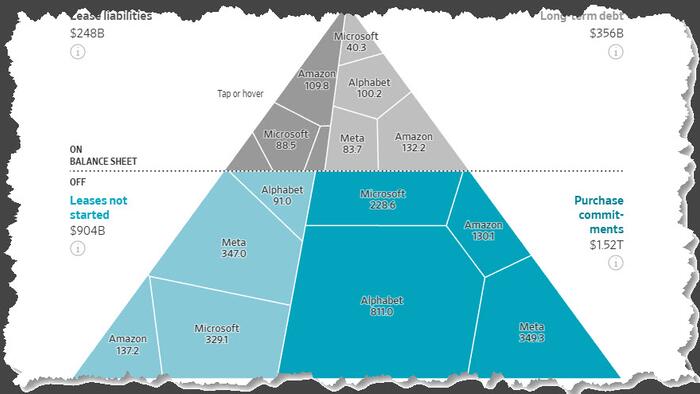
Back in June, we showed this staggering surge in off balance sheet purchase commitment as follows. Needless to say, the latest number is substantially higher.And this is how the WSJ compared side by side the on (capex) vs off balance sheet obligations at the 6 hyperscalers.
Needless to say, the management teams at the big AI spenders are doing everything in their power to cover up just how spectacularly massive their true spending plans are.The WSJ also takes a look at the off B/S SPVs we have been discussing ever since we explained back in January why Meta's Beignet funding model will be imitated by all of its peers throughout 2026 and onward.As a reminder, META is already neck deep in off-balance sheet debt.
Here is a schematic of its $27.3 billion SPV with Blue Owl "Project Beignet" for the Hyperion data center. None of this touches META's balance sheet.
Expect hundreds of billions of these in 2026 https://t.co/794EgSiiZ9 pic.twitter.
com/7hMyVW6Lno — zerohedge (@zerohedge) January 29, 2026Of course, that's precisely what happened and this is how the WSJ lays out the funding of Meta’s gigantic “Hyperion” data-center project in Louisiana, which is the size of about 1,700 football fields, and which "helps explain how big obligations wind up off tech companies’ balance sheets."Meta initially agreed to lease Hyperion for a four-year term starting in 2029, with options to renew for up to 20 years. It guaranteed that it would make bondholders whole if it doesn’t stay the entire two decades.
The company doesn’t think payments under that guarantee are probable, so it hasn’t recorded any liability on its balance sheet.In accordance with accounting rules, Meta’s Hyperion lease obligations will remain off balance sheet until it starts paying rent. It said its aggregate initial lease commitment is about $12.
3 billion. Meta disclosed $347 billion in total obligations for leases that haven’t kicked in yet, including for Hyperion, as of June.This is the WSJ's version of our graphic from 8 months ago: Remember what we said about expecting "hundreds of these in 2026?
" Apparently it came as a surprise to the WSJ, which writes that "across the companies the Journal analyzed, promises of payments under these uncommenced leases totaled $1.2 trillion in off-balance–sheet obligations, or about four times more than what was disclosed a year earlier. In addition to Meta, the Journal reviewed commitments for Alphabet, Amazon.
com, Microsoft, Oracle, Nvidia, Broadcom, SpaceX and Advanced Micro Devices."Of course, as we explained two months ago, the uncommenced leases are just a part of the off B/S liabilities. There's much more: "Data centers get stuffed with a lot of hardware, including the Nvidia chips that are used to train and run models and memory chips that store information.
To buy all that, companies sign long-term contractual agreements well in advance to lock in production from their suppliers."... which is why Nvidia has the most to lose if funding deals that enable the AI bubble aren't in place, which is precisely why the company rushed and forced the various private credit firms to deliver the $500 billion deal announced last week.
Putting a number to it: "Those and other purchase obligations at the companies the Journal examined stand at a whopping $1.9 trillion. Under accounting rules, purchase commitments typically remain off balance sheet until a product or service is delivered.
"The uncommenced leases and purchase commitments are the bulk of the off balance sheet "ticking time bomb" we discussed in June. Only then it was $1.8 trillion.
It has since grown by 50% to $3 trillion.... in two months! And this is how the WSJ redid another one of our June charts:What happens next depends very much on whether or is an optimist...
or not.For the former, the WSJ says that "there are reasons to believe tech companies will make good on all their obligations. Optimists see the skyrocketing demand for AI tools—which has lifted the stock market and led to shortages of key hardware—as a proof point that demand is going to be strong for years, and the money to pay off all these bills will be rolling in.
"As for the others, well the problems are only starting. First, this unprecedented explosion in off balance sheet liabilities in "a worrying sign that some tech companies that once seemed to have fortress balance sheets have neede