
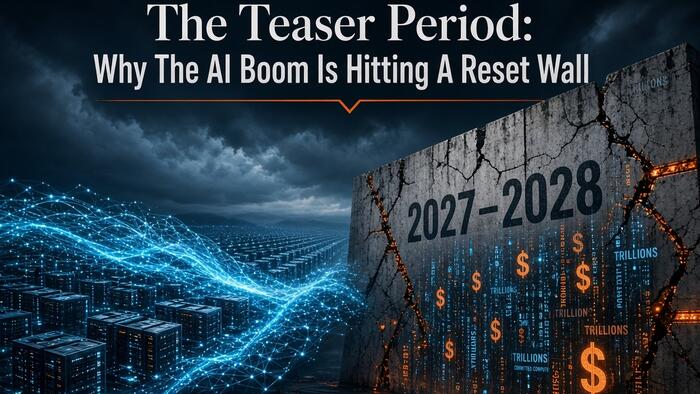
Having laid out, in July, the structural diagnosis that most of the market still refuses to confront: the AI boom is not a technology cycle. It is a credit-driven real-estate-like cycle whose financing architecture depends on the second derivative; the appropriately-named 'Groundbreaker' website has just dropped his next insightful note on what may be the trigger for the market to wake up to the ugly reality beneath the surface of the AI dream.Trillions in signed compute commitments come due in 2027–2028.
The underlying mechanics reveal how the AI boom ends, and when...I. Past is PrologueNothing looked wrong in the summer of 2006.
Home prices had risen for the better part of a decade. Delinquencies were near historic lows. Credit spreads were tight, the ratings held, and the securitization machine hummed.
If you had asked a hundred people on a trading desk whether the American mortgage market was months from seizing, most would have laughed.Millions of subprime borrowers were, at that moment, paying the low introductory rate on a two-year adjustable rate mortgage - the 2/28 ARM. A low fixed-rate for two years, then the rate reset to a payment 30% to 50% higher.
During those first two years the loan performed beautifully: the borrower paid, the servicer collected, and the bond paid its coupon. Nothing looked wrong because the whole complex - housing, mortgages, securitization - was sitting inside the teaser period.Every ARM reset was known, dated, and contractually inevitable from the moment of origination.
Aggregate those reset schedules and you get the most damning exhibit of the era: the reset wall. Roughly a trillion dollars of adjustable-rate mortgages were contractually set to reset across 2007 and 2008 - thirty to forty billion dollars a month at the peak. Credit Suisse published the chart in March 2007.
The IMF reprinted it. It circulated on every trading floor in New York and London.The mortgage reset wall.
Every teaser written in the boom became a dated liabilityFew understood it. Paulson & Co. laid out the arithmetic that same month in a comment letter to the FDIC: Over 80% of recent subprime originations, it observed, were two- or three-year adjustable-rate products.
The average subprime borrower’s mortgage payments already consumed roughly 40% of their gross income at the teaser rate. Almost none of them could service the reset rate out of income.The crisis, in other words, was written in advance by the instruments themselves.
The market looked at the reset wall and kept buying, because every participant believed the exit would arrive before the reset: home prices would keep appreciating and the borrower would refinance into a fresh teaser before the old one expired.We have spent the last eighteen years describing the financial crisis as a shock - a black swan, a hundred-year flood, a tail event. It was none of those things.
Every reset on that chart was contractually inevitable from the moment of origination. The defaults were not primarily caused by an exogenous macro shock, a spike in unemployment, or a recession that arrived first. They were the scheduled mathematical consequence of loans that assumed perpetual appreciation.
The mortgages were built to break.The AI boom has rebuilt this exact structure, and the market is once again underwriting the teaser.It has a reset wall of its own - a schedule of dated, contractual, non-negotiable payment shocks - hiding inside the trillions of dollars of compute contracts signed by OpenAI and other frontier labs since 2024.
The take-or-pay compute contract - the instrument at the center of the AI build-out - has a structural feature that almost no one prices: its payments do not begin at signing. They begin at delivery. A lab signs a multi-year capacity commitment today, but the payments do not start until the data center is energized, the capacity is accepted, and the contractual ramp schedule commences - an interval set not by finance, but by construction: siting, powering, and filling a gigawatt-scale campus takes 24-to-36 months from signature - mirroring the two-to-three-year teaser of a subprime ARM.
More than $2.3 trillion of compute contracts now sit on the books of the four largest American cloud providers as remaining performance obligations and contracted backlog - signed, celebrated, capitalized into equity prices, and, critically, not yet billing.During the teaser period, everyone wins.
The seller reports backlog growth that compounds at rates no operating business has ever sustained - Oracle’s RPO grew 363% in a single fiscal year. The buyer - a frontier lab burning cash at historic rates - books no expense because the capacity does not yet exist. The market capitalizes the booked number as if it were revenue and ignores the billed number as if it were a technicality.
And then, on a schedule fixed at signing, booked compute becomes billed compute. The take-or-pay clock starts. From that day forward, the frontier labs and the hyperscalers incur those costs regardless of utilization.
The invoice is a function of the contract, not of demand. That is the reset.The parallel to 2006 is exact and it explains the single most-cited absurdity of this cycle: How does OpenAI, a company with some $40 billion of run-rate revenue, sign $1.
4 trillion of compute commitments? The same way a household with $60,000 of income signed a $600,000 mortgage: because the terms at signing do not require the payment yet, and because everyone at the table - borrower, lender, and the market - believes the growth will arrive before the payment does.The 2/28 borrower’s defense was always the same: by the time the reset arrives, my house will be worth more and I will refinance.
The frontier lab’s defense is structurally identical: by the time the capacity commences, my revenue will have grown into the obligation.The compute commencement wall can be made visible in exactly the way the reset wall was visible in 2007 - from disclosed contracts and delivery schedules. The only question is whether the market listens this timeThe same chart twenty years apart.
Left panel - first-reset principal balances per Credit Suisse and Inside Mortgage Finance. Right panel - announced compute commitments and contract disclosures across every frontier lab.II.
The Anatomy of a TeaserTo see why the structure behaves the way it does, I’ll break down a single contract and walk the lifecycle. The terms below are hypothetical; the architecture is the standard one visible across the disclosed OpenAI–Oracle, Anthropic–Google, Meta–CoreWeave, and OpenAI–CoreWeave arrangements.A frontier lab signs a $12 billion, ten-year capacity commitment with a compute provider.
The contract is take-or-pay, meaning the lab commits to payments once the capacity is delivered, and delivery requires a campus that does not yet exist: two years of construction, procurement, and power work stand between signature and completion.Now look at what each party’s financial statements show during the two-year teaser.The seller - a hyperscaler or neocloud - books the arrangement into RPO or contracted backlog on day one - the full $12 billion, disclosed, quoted, and celebrated.
The market values it as contractual future revenue. Meanwhile the seller’s cash flow statement hemorrhages: the campus is being built, so capex runs far ahead of receipts. Booked backlog rises; reported earnings feel none of the buildout; financing frequently sits off-balance sheet.
The buyer - a frontier lab like OpenAI or Anthropic - announces access to the compute it needs to pursue its scaling roadmap, and its private valuation reprices on the announcement. The commitment is a future obligation, disclosed - if at all - deep in a contractual-obligations footnote or, for the private labs, nowhere public. No expense hits the P&L because no service is being received.
A lab that has committed tens of billions across multiple providers carries a cost structure that reflects only its commenced capacity