
Authored by Patrick Feeley via Substack,Private credit is financing the AI buildout against collateral with a short clock, and I think Washington ends up holding the risk...Karp's logicAlex Karp, one of the most contrarian CEOs ever, spent September making an argument most of the market has not yet absorbed, and I am writing this because I think it applies one layer further down the stack than he took it. I admire the way he reasons.
He holds a doctorate in social theory from Goethe University Frankfurt, and it shows in a habit I find rare among technology chief executives, which is to treat the state and the tech industry as one system and to say plainly what the people inside it prefer to leave unsaid. His 2025 book The Technological Republic, written with Nicholas Zamiska, argues that the software industry has to work with government, and it asks leaders to preserve space for ideological confrontation and to risk the disapproval of the crowd. As I read him, the frontier labs carry liability too large for any public market to hold, so the only buyer of that risk is the sovereign.
He told CNBC the only way to deal with that liability is "to go to the government and say, nationalize us, please". I think he is right, and his reasoning reaches well past the labs to the debt that built the buildings the models run in.The AI buildout is being financed by private credit, against collateral that loses most of its value in four to six years, leased to a handful of tenants.
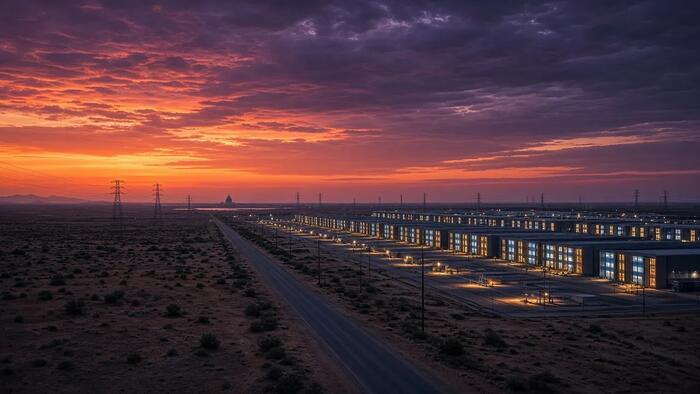
When the first large tenant walks, lenders will discover they own stranded GPUs in the desert. Washington has already begun treating compute as strategic infrastructure, and I expect it will not let those facilities go dark. Data center credit then becomes what mortgage credit became after 2008, with private gains and a public backstop.
Karp followed the liability to the place where only the government is large enough to stand behind it, and he said so out loud on national television. That is the discipline I want to borrow, because the same chain of reasoning leads straight to the lenders.Who paysMorgan Stanley forecasts about $2.
9 trillion of global data center capex through 2028, roughly $1.6 trillion of it chips and servers and the rest buildings and infrastructure. Hyperscaler cash flow covers about $1.
4 trillion and leaves a $1.5 trillion external financing gap, of which the bank's analysts see private credit filling about $800 billion. That is one bank's forecast of what private credit could supply, and the same figure turns up in the Financial Stability Board's private credit report with Morgan Stanley as its source.
Morgan Stanley was also the sole bookrunner on the Hyperion bond, so it has a commercial interest in the story.The marginal dollar is moving away from public markets. Demand coverage on hyperscaler bond deals fell from nearly five times in February to below two times in July, which I read as financing shifting toward private credit and off-balance-sheet vehicles.
The template is Meta's Hyperion campus in Louisiana. Funds managed by Blue Owl own 80% of the joint venture's equity and Meta owns 20%. The project's bonds total $27.
3 billion and were anchored by PIMCO. Meta leases the campus on an initial four-year term with renewal options, and Meta's latest 10-Q puts its maximum exposure to loss on its unconsolidated data center ventures at $68.4 billion at September 30, including $41.
5 billion of residual value guarantees. An IFR opinion column by an outside author, a former UBS banker, describes the A+ rated bonds and a 16-year residual value guarantee, compares the deal to off-balance-sheet structures from the Enron era, and in its body calls it a corporate-scale version of the accounting that let Fannie Mae and Freddie Mac fund inside their standalone credit, with Meta carrying the economic risk while the debt sits outside its books.Hyperion is one of many such deals.
By the Financial Times's count, tech firms had moved more than $120 billion of AI data center spending off their books through special purpose vehicles as of December 2025, a figure that includes a $20 billion xAI raise still being pursued at the time. The bondholder is lending to Meta, and Meta's balance sheet does not say so.The clockA building lasts thirty years while the chips inside it do not.
Nvidia's H100 rented for about $8 an hour on demand in summer 2023, against $1.70 in October 2025 and $2.35 in March 2026, which are midpoints of SemiAnalysis's one-year contract ranges.
The comparison mixes an on-demand price with contract prices, and like for like on SemiAnalysis's spot composite the fall from late 2023 to October 2025 is closer to 57%. CoreWeave depreciates its servers over six years, and Nebius used four until this January and now uses five. When the companies holding the same kind of asset keep revising its useful life, the lender does not know what it owns.
The market has quietly admitted this. CoreWeave's investment-grade-rated facility from March priced at 225 basis points over SOFR, while its facilities signed since then price at 450 and 550, the newest backed by customers that are unrated or speculative grade, on broadly the same chips. The GPU matters less than the tenant's promise to pay.
CoreWeave owed $35.6 billion of principal at June 30, 2026, of which $13.6 billion was GPU-backed delayed-draw loans, and Moody's rated its first investment-grade GPU-backed facility A3 in March.
By August its newest facility priced at SOFR plus 550, and Octus reported a recent deal pricing at 96 to 97 cents on the dollar, a junk cost of capital.The guarantees that hold the structure together are circular. Nvidia has residual value guarantees capped at $105 billion for its initial commitment behind OpenAI's leases at the Ohio PORTS campus, payable to the lessor, SB Energy, if OpenAI defaults, and the total with guarantees for other partners comes to $108.
5 billion. The cap is a ceiling and not current exposure, and the guarantees take effect as each lease commences, with the first phase expected in fiscal 2029. OpenAI has agreed to reimburse and indemnify Nvidia for any payout, a promise that is only worth something in the world where the guarantee is never called.
What the market sells as diversified asset-backed credit is concentrated exposure to four or five tenants and one supplier's product cycle, packaged as infrastructure.The cracksNone of what follows is a default, and all of it is the market repricing who holds the risk.Oracle invoked force majeure on Project Jupiter, the New Mexico campus it leases from Blue Owl's Stack Infrastructure.
Bloomberg reported the notice on September 23, and if the parties agree power delays qualify, Oracle could defer rent for up to three years, though Oracle says such notices are commonplace and do not by themselves establish a project delay. The project's financing debt was quoted near 90 cents in September and has since traded near 80. The underwriters, meanwhile, want out.
A bank group including JPMorgan and MUFG arranged $38 billion of construction debt for Oracle-leased projects in Texas and Wisconsin, and Bloomberg reported in April that it was taking months to spread across the market.Issuance has gone junk. Close to half of the roughly $80 billion of data center bonds issued in 2026 are rated below investment grade, which is $37 billion against $8.
6 billion in 2025, so the share rose from about 24% to 46% and the dollar volume is more than four times last year's. Firmus, SB Energy and AirTrunk delayed or shelved IPOs within a month. Hyperscaler credit is at its widest as well, with five-year CDS nearing its widest level of the year in early October and Oracle's at 257 basis points by October 10, the highest since at least 2009.
Behind all of it sits an enormous pipeline, since Microsoft, Amazon, Alphabet, Meta and Oracle report about $1.2 trillion of undiscounted payments on leases that have not yet commenced.Washington holds itNothing on the public r