
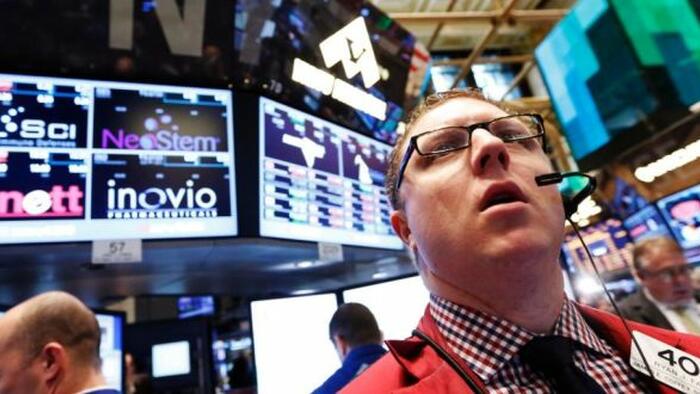
US equity futures are lower with Tech underperforming as oil prices / bond yields move higher (although off session highs), both in response to an acceleration in "kinetic hostilities" in the Middle East. As of 8:00am ET, S&P futures are down 0.1%, off session lows, while Nasdaq futures rise 0.
4% after Dell shares jumped after the company boosted its annual sales forecast by $25 billion. In premarket trading, Semis / Memory are weaker and AVGO is -53bp with earnings after the Close today. Mag7 are mostly lower as are Software names with Hardware buoyed by earnings.
Defensives and Energy gain while Cyclicals drop. According to JPM's Market Intel team, which on Monday turned Neutral on stocks (from Bullish), equities will continue to struggle until crude / rates stabilize. Europe’s Stoxx 600 retreated 0.
7%, while Asian stocks fell the most in two weeks. WTI trades around $90/bbl as the yield curve steepens, having erased gains from Bessent’s "Treasury Twist". The Dollar is also higher as the Debasement trade continues to struggle.
Commodities are mostly lower with Energy the lone bright spot and Ags underperforming Metals; keep an eye on gold to see if $4,300 acts as support. Today’s macro data focus is on the August ADP employment change (8:15am) and July factory orders (10am). Fed calendar is blank apart from Beige Book release at 2pmIn premarket trading Mag 7 stocks are mixed (Alphabet +0.
1%, Apple +0.2%, Tesla +0.1%, Nvidia -0.
1%, Meta -0.2%, Amazon -0.2%, Microsoft -0.
4%)Credo Technology (CRDO) falls 9%, suggesting that the communications equipment company’s second-quarter revenue forecast beat was not good enough to impress investors after the stock’s 44% rally this year.Dell Technologies (DELL) jumps 8% after the company boosted its annual sales forecast by $25 billion due to surging demand for servers to run artificial intelligence tasks.EyePoint (EYPT) slips 3% after TD Cowen downgraded the drug developer to hold, citing a challenging regulatory path following a trial failure for an eye disease drug.
FuelCell (FCEL) tumbles 15% after the power plant builder reported revenue for the third quarter that missed the average analyst estimate.G-III Apparel (GIII) falls 10% after the clothing company posted disappointing second quarter sales and provided a third quarter revenue forecast that also missed expectations.GitLab (GTLB) surges 21% after the software company boosted its revenue guidance for the full year, beating the average analyst estimate.
Knife River (KNF) falls 2% after JPMorgan analyst Adrian Huerta cut the recommendation on the building materials company to underweight, writing that he doesn’t expect a “meaningful change” in public funding in Oregon, its largest market.MongoDB (MDB) is down 12%, with growth in the software company’s Atlas product seen coming in below elevated expectations. However, analysts are broadly positive on the results overall, which topped expectations, while the full-year forecast was raised.
Sprinklr (CXM) falls about 2% after reported second-quarter revenue that was slightly weaker than expected; the software company’s stock has soared about 55% off a June low, as of its last close.In other corporate news, Nvidia is in advanced talks to acquire artificial intelligence startup Hugging Face in a transaction that may total about $14 billion. Artificial intelligence coding startup Cognition AI is set to close a new round of funding that would vault its valuation to about $47 billion.
GitLab shares rally as much as 20% in premarket trading after the software company beat second-quarter expectations and boosted its full-year forecast.Brent crude hovered near $94 a barrel and WTI traded around $90 (although it has since dipped below) after Washington carried out its second round of attacks against Iran in three days. US diesel prices hit the highest since April.
Bonds fell in most major markets, with the 30-year Treasury yield trading at 5.28%, near the 19-year high hit before Treasury Secretary Scott Bessent’s recent intervention. Chipmakers were under pressure in premarket trading even after Dell surged on a strong revenue forecast.
The latest rally in energy prices is compounding worries about persistent inflation, pushing up the premium traders demand for bonds already straining under heavy government spending and corporate demand. Traders put the odds of rate hikes this month at more than 50% for three major central banks, including nearly 70% for the Fed. “The new baseline seems to be that the Fed will, after all, hike rates in September,” wrote Chris Turner at ING Groep NV.
“Fed Chair Kevin Warsh has made it reasonably clear that inflation is not falling quickly enough to target and, given a reasonably strong economy, the Fed will need to act.”While the selloff in bonds is showing few signs of letting up, the relatively modest moves in yields have offered traders some assurance. The retreat has been orderly and broad-based, rather than driven by credit risks or liquidity stress, said Stephan Kemper at BNP Paribas Wealth Management Germany.
“It suggests the market is pricing a higher-for-longer rate path, not a credit event or recession,” Kemper said. The key to lower yields lies in inflation expectations, he said, adding that any relief on longer-dated rates could “trigger a strong move higher in equities as fundamentals remain very strong.”Dell became the latest company to reinforce optimism around the AI trade.
The company increased its annual sales forecast by $25 billion in a further sign of surging demand for servers to run AI tasks. The stock — already the third-biggest boost to the S&P 500 after a 240% rally this year — jumped another 9.3% in premarket.
Shares of HP Enterprise, which reports earnings after the market close, also rose, advancing 5.2%.Yet, there are signs that investors are addressing lingering worries about high AI-linked valuations by expanding exposure.
Around 115 S&P 500 stocks are on Evercore ISI’s “negative beta” list, where the rolling six-month one-day percentage change is inverse to the benchmark. The share has crossed levels last seen in the dot-com bust in 2000-2001, suggesting that “investors have proactively sought diversification” rather than waiting for a “bubble burst,” strategist Julian Emanuel writes.Robust signals from Corporate America are offering equities a measure of support.
Corporate cash piles are back to record highs despite the surge in AI spending, according to analysis by Societe Generale SA. Investors have also continued to pour money into equities, with global stocks attracting about $1.1 trillion this year, the strongest inflows since 2021, according to data from HSBC Holdings Plc.
While stock markets have remained relatively resilient, “that’s likely going to change once Treasury yields and Japanese yields break through current resistance levels,” said Patrik Lang at Global Gate Asset Management. “Positioning is a bit stretched, and short-term indicators are at overbought levels,” he said. “All of that points, regardless of the fundamental situation, to consolidation in the coming weeks.
”Elsewhere, governing Council member Joachim Nagel indicated that the European Central Bank will raise borrowing costs next week, though he stayed wary on what comes after that. Bank of Japan Board Member Hajime Takata, one of the bank’s most hawkish members, also left the door open for an outsized interest-rate increase. European stocks are heading for a third day of declines, while futures are also pointing to a lower open on Wall Street as rising bond yields continue to deter investors.
Higher oil prices continue to play a role, with Brent crude futures at around $95 a barrel. European natural gas futures have risen close to 3%. Here are the biggest movers Wednesday:Deutsche Bank shares rise as much as 2.
5% to trade at a new 15-year high after Goldman Sachs analysts upgraded the German lender to buy, predicting it to deliver faster earnings growth than the wider sector fr