
It took just a few hours long for the AI unwind to go from a Wall Street problem to an Asian government problem.After the post-midterm "sell everything" day in which the Nasdaq suffered its worst day since Covid and the SOX plunged 12%, Asia opened on Friday into a liquidation: Taiwan's Taiex plunged as much as 9% and entered a bear market, Korea's Kospi crashed as much as 8.8%, tripping a 20-minute market-wide halt and briefly breaking below 5,000, and the Nikkei joined the bear market club with a 6% drop.
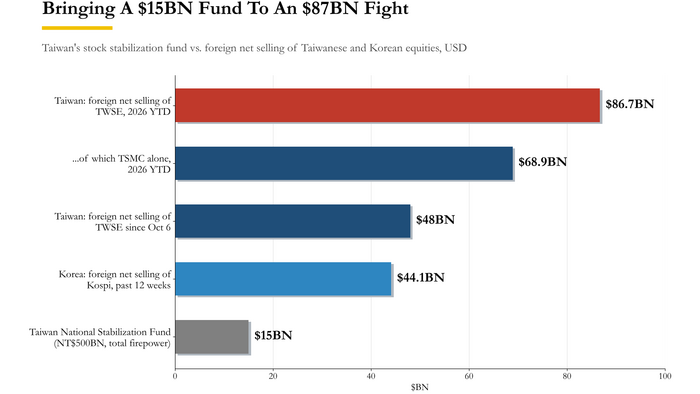
By the time Europe woke up, both Taipei and Seoul had pulled the emergency brake.In Taiwan, according to Bloomberg, the Financial Supervisory Commission will impose curbs on short selling from Nov. 9, while the Finance Ministry said it is prepared to deploy its NT$500 billion ($15 billion) stock stabilization fund.
In Korea, Deputy Prime Minister and Finance Minister Lee Hyoung-il promised "proactive" measures to stop the market "from reacting excessively relative to the fundamentals of our economy," and backed it up by suspending the margin-loan collateral rule that forces brokers to dump leveraged retail positions.We saw it coming. At 9:06pm ET on Thursday, hours before the official announcements, we tweeted that Taipei was heading straight to bailouts:And straight to bailouts*TAIWAN TO UNVEIL STOCK STABILIZATION ACTS THIS AFTERNOON: PAPER https://t.
co/FV1ozJCULZ— zerohedge (@zerohedge) November 6, 2026Which is about as surprising as the sun rising in the east: these are the same two governments, using the same playbook, that have tried this before. The question is whether it works any better this time, when the thing being sold is the AI trade itself.Taipei Dusts Off The April 2025 Crisis KitThe Taiwanese package is, almost to the decimal point, a rerun.
The FSC will cut the cap on intraday short-sale orders of borrowed securities to 3% of a stock's average daily volume over the prior 30 days, down from 30%, and raise the minimum margin requirement for short sales to 130% from 90% (Goldman's Asia prime desk flagged the regulator's notice to clients within minutes, helpfully offering to "help with long sell borrow over the weekend"). Those are exactly the numbers Taipei rolled out in April 2025, when Trump's Liberation Day tariffs crushed the Taiex into a bear market.The Finance Ministry, for its part, did not mince words: it pointed to continued foreign selling as evidence of "a significant deterioration in market confidence.
" Which, in fairness, is the most honest thing any official said on Friday.The damage was historic. The Taiex closed down 4.
5% after the intraday plunge, but still posted its biggest weekly loss since 2001, while TSMC, which had been down nearly 10% at the open, closed 4.7% lower. According to Goldman's Asia desk (available to pro subs in the bank's Regional Wrap, futures and TSMC touched limit down, the OTC index had already erased its YTD gain, and the client chatter "focused mostly on retail capitulation and a potential short-selling ban.
" The desk itself "was very busy selling and shorting intraday, probably the highest activity level in the past three months."Translation: everyone saw the short ban coming and got their shorts on before the door closed. Market efficiency at its finest.
Foreigners Sell, Locals Catch KnivesTaipei's real problem is the size of the foreign exit. In his latest flow and positioning observations (available to pro subs), Goldman's Harrison Flagler lays out the numbers, and they are brutal:FINI outflow on Thursday of USD$3.1bn extended the selling streak to a 6th consecutive sessions totaling USD$19.
2bn in outflows (and that is part of a larger trend of selling 19 of twenty sessions since 10/6 totaling USD$48bn outflows). In contrast, local funds continued to net buy for an 18th consecutive session, buying USD$11bn over that period. As a result, this extended the divergence of foreign vs local funds activity YTD, with FINI having net sold USD$86.
7bn in the TWSE (incl. USD$68.9bn in TSMC), vs local funds having bought USD$33.
5bn in the TWSE (incl. USD$10.6bn in TSMC).
Here is what that divergence looks like (chart source: Goldman, Bloomberg):Bloomberg's tally is a bit more conservative at "only" $45 billion-plus of foreign net selling this quarter, but either way the math is not kind to the stabilization fund. NT$500 billion is about $15 billion, or roughly one-third of what foreigners have pulled out since Oct. 6, and one-sixth of this year's exodus.
Put differently, Taiwan just brought a knife to a gunfight:The defense extends to the currency, too. Bloomberg reported that USD/TWD briefly hit 33.04, its highest since April 2025, before the Taiwan dollar reversed to close 0.
3% stronger at 32.768 per dollar as exporters, state-owned banks and life insurers sold dollars, the usual proxies when Taiwan's central bank would rather not leave fingerprints. Regular readers will recall that Asia's central banks were already dumping dollars to fight the tape back on Oct.
15, the day the AI unwind first went global and Taiwan suffered a record ~$9.3 billion foreign outflow. That record didn't last long either.
Meanwhile, the local buyers propping up the market are increasingly leveraged ones. Goldman notes that the retail margin balance dropped 3.4% on Thursday to its lowest since Aug.
31, but "as a percent of market cap, the margin balance remains near the recent highs" (chart source: Goldman, Bloomberg):In other words, the forced-selling fuel hasn't burned off yet, which may explain why Taipei is going after the shorts instead.Seoul Suspends Margin Calls (Again)If Taiwan's day was historic, Korea's was merely the latest in a year of historic days. The Kospi tumbled as much as 8.
8% at the open, triggering a circuit breaker, in a year that had already produced eight of the Kospi's 14 circuit-breaker halts since the Dot-Com era by late July. It closed down 6% at 5,059.7, as SK Hynix sank 10.
4% and Samsung 6.4%. We put the round trip in perspective overnight:KOREA’S KOSPI TUMBLES BELOW 5,000 MILESTONE, DOWN 46% FROM JUNE HIGHnow up just 16% for the year, was up 116% https://t.
co/keEq72rAwP— zerohedge (@zerohedge) November 6, 2026Seoul's response came within hours:And another*SOUTH KOREA TO EASE MARGIN RULE FOR 3 MONTHS AMID STOCK ROUT https://t.co/UjAclClSVO— zerohedge (@zerohedge) November 6, 2026Specifically, starting Nov. 9, brokers will be exempt for three months from the requirement to maintain a 140% collateral ratio on margin loans, so they don't have to liquidate retail accounts as prices fall.
It is the first such reprieve since July 2022 (and before that, March 2020), and officials said more steps are ready if volatility widens.The catch? The waiver is optional, and the brokers are the ones left holding the bad debt.
According to the Seoul Economic Daily, same-day responses were limited to lowering collateral ratios by 10 to 20 points for clients who apply and deferring forced sales by one day, and critics point out that the 2020 version was followed by large-scale forced selling a week later. One unnamed securities official estimated that a 10-point cut buffers roughly another 7% decline. Which, given that the Kospi just fell 8.
8% in a morning, is not a lot of buffer.Goldman's Seoul desk, for its part, argues the leverage has already been flushed. In the bank's Korea market wrap, Emily Jee writes that "a cleaner setup in margin balance may have helped prevent an amplified post-circuit breaker sell-off, with margin loan balance relative to market cap currently sitting at 0.
6%" (chart source: Goldman GIR, John Kwon):Indeed, margin loans have fallen to about 28.6 trillion won, down 26% from the June 24 peak. The problem is that the dip buyers are running low on ammo too: investor deposits have collapsed 36.
6% from their June peak to 88.5 trillion won, even as retail investors scooped up a net 4.5 trillion won over the past six sessions while foreigners dumped 12 trillion won.
The foreign selling, meanwh