
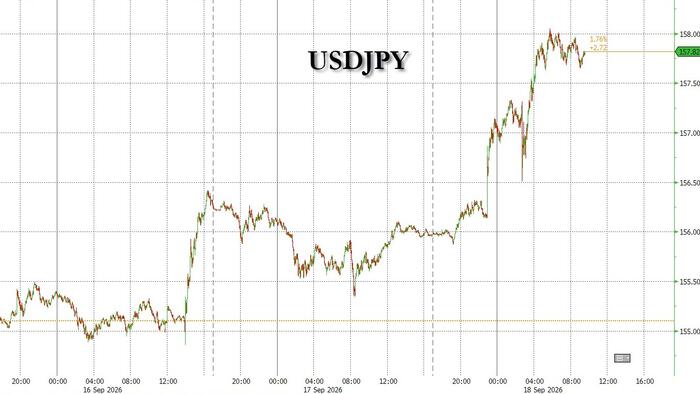
Update: (12:40pm ET)The Bank of Japan, not to mentioned Scott "the House" Bessent, have been most displeased with the yen plunge following today's BOJ rate hike, and so they once again do what they do pretty much every other week now: intervene in the market. As we said earlier (see below) when we predicted that some sort of central bank intervention was inevitable, the yen pared declines on Friday after Japan's Nikkei newspaper reported that the Bank of Japan had conducted a rate check in the foreign-exchange market.Just as it was intended, the report immediately reversed some of the yen’s huge losses triggered earlier in the session by disappointment among traders who had wanted clearer guidance from the central bank on its plans to raise borrowing costs further to stabilize inflation, following a widely expected rate increase on Friday.
Instead, what they got were two dissenters appointed by the ultradovish Prime Minister Sanae Takaichi, with two more members due to leave the board next year and likely also replaced by more dovish policymakers, thus kneecapping expectations for more rate hikes. Such intervention is meant to squeeze speculative yen shorts and accelerate a move in thin markets, but its ability to produce a lasting reversal may depend on monetary policy. The Fed’s renewed tightening cycle threatens to keep the US-Japan rate differential wide even after Friday’s BOJ rate increase, preserving the incentive for investors to borrow in yen to fund higher-yielding positions elsewhere.
Speculative positioning is also lighter than before the previous intervention. Leveraged funds halved their bearish yen bets in the week through Sept. 8, according to CFTC data, leaving fewer short positions to squeeze if authorities step in again.
The Japanese currency was down 0.6% at 156.83 per dollar at about 12:30 p.
m. ET after losing as much as 1.3% earlier in the session.
The Nikkei reported that the BOJ inquired with market participants about exchange-rate levels, without saying where it got the information. Such a move has previously preceded official intervention. “This is too little, too late,” said Win Thin, chief economist at Bank of Nassau 1982.
“The BOJ had another chance to go big and they missed it, same as July. If they really wanted to boost the yen, they should have hiked more than expected and then intervene massively.”As reported earlier, the yen had weakened to about 158 per dollar after BOJ Governor Kazuo Ueda sent mixed signals on the path for future rate hikes following the bank’s widely expected increase.
While he said the stage for policy setting has shifted, he also said it was difficult to determine the terminal rate for the current tightening cycle. Analysts saw his remarks as falling short of the market’s increasingly hawkish expectations.Japan has entered a holiday period through next Wednesday, when thinner liquidity could amplify the impact of any official intervention.
Authorities used a similar window around the Golden Week holiday period this year, first stepping in after the yen weakened beyond 160 just before the holidays and then apparently intervening again during the thinly traded period.Of course, neither of the previous interventions worked, and this one will fail as well. Japan and the US conducted a coordinated yen-buying operation this summer, the first since 1998, raising the stakes for traders betting against the yen.
Japan spent a record ¥15.4 trillion on intervention in the month through Aug. 26, according to Finance Ministry data.
US Treasury Secretary Scott Bessent has since continued to signal support for a stronger yen.Despite the coordinate global attempts to boost the yen, the fundamental pressures weighing on the yen remain in place, including Japan’s wide interest-rate gap with other major economies, concerns over the fiscal outlook under Prime Minister Sanae Takaichi’s expansionary spending plans, and - of course - the biggest debt load in history, where every rate hike will lead to much more interest expense.* * *Earlier:The yen sank to a two-week low against the dollar on Friday after two policy makers at the Bank of Japan dissented from a widely expected decision to raise interest rates, extinguishing expectations for back-to-back hikes.
Governor Kazuo Ueda now needs, at a minimum, to preserve expectations for a December move to prevent markets from unwinding most if note all of the tightening path already priced into rates.While Japanese policymakers pushed rates to their highest level in 31 years at 1.25%, the move failed to boost the currency as traders felt there was a lack of explicitly hawkish guidance.
As a result of the dovish split, the yen tumbled and the US dollar rose more than 1.2% against the Japanese currency, hitting a a two-week high of 158.07 yen after wavering during BOJ Governor Kazuo Ueda's press conference.
It was set for its biggest daily increase versus the yen since December and the largest weekly rally since September 2024.Traders had already discounted the equivalent of another hike by year-end before today’s policy meeting, leaving a high bar for any hawkish surprise. The presence of two dissenters signals that support for another rate increase in October is weakening, with OIS assigning around a 20% probability to such an outcome.
That leaves Ueda’s press conference carrying the burden of preserving expectations for a December hike and keeping the BOJ on a tightening path that at least matches the Fed’s recent pace."They've just clearly underwhelmed versus expectations here," said Ray Attrill, head of FX strategy at National Australia Bank in Sydney. "And I think that one of the more staggering aspects of it was that they couldn't even get the unanimous vote for that," he said.
"That really raised eyebrows in the market.""The statement offered little additional hawkish guidance to support bullish Japanese yen positions," said Frantisek Taborsky, currency strategist at ING. "The dissent from (Toichiro) Asada and (Ayano) Sato points to resistance against the fastest pace of rate increases in more than three decades and suggests they may increasingly act as a brake on further tightening.
"According to Mizuho strategists, the dissenters raise concerns that further rate hikes become harder to deliver, potentially steepening the JGB yield curve. Senior strategist Masayuki Nakajima said that Friday’s two dissenters were appointed by Prime Minister Sanae Takaichi. Two more members are due to leave the board next year and could potentially be replaced by more dovish policymakers“Should their successors come from the reflationist camp, four of the nine Board members would become dovish,” he says; “While that would still fall short of a majority, it could reinforce expectations that sustaining the tightening cycle may become more difficult in the future”“If so, concerns that the BOJ is falling behind the curve could re-emerge, potentially leading to further curve steepening,” he added.
Commenting on the market reaction, Bloomberg's Ven Ram said that the decision was: marred by dissent from two policymakers who voted against the hike;there was none who called for a bigger margin of increase;and the accompanying statement, while vowing to continue raising rates, failed to signal a sense of urgency by not saying when they will come.Japan’s benchmark rate still trails the neutral rate by a considerable margin, and without back-to-back interest-rate hikes, the yen will stay weaker for longer. Only the franc carries a lower interest rate in the G-10 economies, with the Swiss central bank due to meet next week.
Should that monetary authority reiterate its preference for keeping rates at zero, it will engender low volatility in two of the major exchange rates that represent the preferred funding currencies.After a slew of central bank meetings and with Brent crude headed for the first weekly decline this month, global bonds that were deeply oversold are finding some respite. Longe