
SummaryExplosions in Jordan reported amid initial Iranian retaliation, drones on Bahrain.Reports of fresh US strike wave on southern Iran, oil soarsBessent Says Hormuz Will Be "Worthless Piece of Water" In Two YearsIran offers conditional ceasefire: Pezeshkian says Iran will return to talks if the US honors prior commitments, which Tehran says it has violated.Tankers hit in Strait of Hormuz: Two supertankers struck exiting Hormuz, escalating energy-market risks.
Oil prices surge: Brent crude rose above $92/barrel.Diesel supply squeezed: Refinery disruptions are driving diesel prices and margins sharply higher.Strait of Hormuz traffic returns to normal by October 31?
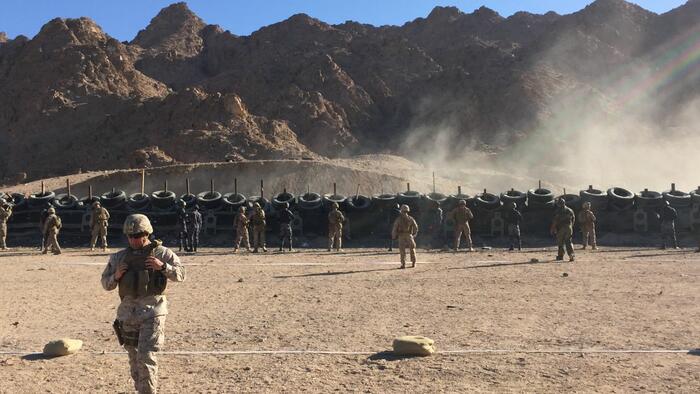
Yes 12% · No 89%View full market & trade on Polymarket * * *Iran Targets Marine Barracks in Jordan, Drones Sent on Bahrain, KuwaitIranian state media is saying that the military retaliation is ongoing, with the Islamic Revolutionary Guard Corps (IRGC) Aerospace Force announcing that it launched a heavy ballistic missile attack targeting the US Marine barracks at Camp Titin, located near the Gulf of Aqaba in Jordan - which is at a significant distance, in the country's far southwest corner. State media sources further detail:According to the IRGC, the strike destroyed multiple military installations and attack helicopters, inflicting heavy casualties on U.S.
forces. The operation was executed as the second wave of retaliatory actions under the code name “Ya Rasul Allah.”And more via state WANA News Agency: "The IRGC stated that the action was carried out in retaliation for a U.
S. strike on a residential home during a wedding ceremony in Sirik, which resulted in nearly 50 civilians killed or injured, including children." Iranian claims of US casualties will as usual be hard to verify, but CENTCOM has said no casualties have resulted, per news wires:US officials says no US casualties from Iranian attack on facilities in Jordan so farIn the wake of the US CENTCOM campaign, which may still be ongoing, Iran's Hormozgan grid is under blackout.
Further damage is likely to be assessed and publicized in the coming hours. Bahrain, Kuwait also targeted:Iran's army launched drone attacks on the US base in Bahrain, according to Fars News AgencyKuwait Army says air defenses are confronting attacks by hostile dronesJordan intercepts 10 ballistic missiles from Iran, three fell in remote areas: armyInitial unconfirmed footage now widely circulating of alleged IRGC attack on Jordan base...Footage of an Iranian medium-range ballistic missile hitting a target near Aqaba, Jordan moments ago.
pic.twitter.com/OTRmWBiuXL — OSINTtechnical (@Osinttechnical) September 1, 2026Iranian Retaliation on regional Bases BeginsIran is already hitting back, according to some early reports of what looks to be their latest retaliation, despite President Trump having earlier warned the Islamic Republic will be hit harder if it responds.
"If the failed Nation of Iran retaliates for this very justified attack, they will be hit again at a much harder and higher level, but it will not be the biggest attack of them all, that is waiting in the wings and, when it is over, there will be very little left of the Islamic Republic of Iran!" he stated earlier.The White House indicated it is focused on taking out IRGC targets.
But this has triggered the expected reaction:Fars: Some Arab sources report that an explosion was heard in Jordan; several explosions were heard from American bases in JordanIRGC says US attacks will tighten the lock on the Strait of HormuzExplosion heard in Erbil, Iraq, reports FarsThe last tit-for-tat instances also saw US bases in Jordan targeted.One Atlantic Council analyst points out the obvious - today's action is yet another indication that the administration still does not understand how the Iranian government and leadership thinks (unless the intent is actual runaway escalation). Danny Citrinowicz writes:Threatening Tehran with even more devastating strikes if it retaliates is unlikely to prevent an Iranian response.
In fact, it may do the opposite. From Tehran’s perspective, failing to respond to a direct U.S.
attack would undermine the very deterrence equation Iran has spent months trying to establish. The Iranian leadership believes it must demonstrate that American military action carries a price. That means Iran is likely to retaliate and it may even conclude that a broader or more painful response is necessary precisely to rebuild deterrence against future U.
S. attacks.This is the fundamental problem with Washington’s approach: it assumes that sufficiently strong threats will convince Iran to back down.
But Tehran may draw exactly the opposite conclusion, meaning that backing down under threat would invite additional American strikes. Threats will not solve this problem. If Washington wants to prevent another cycle of retaliation and counter-retaliation, it needs a political strategy for ending the confrontation.
Otherwise, each side will continue using force to restore deterrence after the previous round — creating an escalation cycle that becomes increasingly difficult to control.The latest Pentagon leaks to the Washington Post happened days ago, and now this:Looks like the high-level Pentagon leaks and resignations of the past week were meant to forestall or prevent exactly what’s happening now. Didn’t work of course.
There are no checks on power, unless Israel gets upset. We don’t even have an opposition party to speak of. https://t.
co/5m1DaLirOg — Mark Ames (@MarkAmesExiled) September 1, 2026More latest via AJ:The United States military says it is striking targets in Iran over attempted attacks on shipping as Iranian media reports explosions in Asaluyeh, Jiroft, Bandar Abbas, Qeshm Island, Konarak, Chabahar, Jask, Sirik and Lavan.Iran’s army and IRGC promise the US will regret and face “severe punishment” for the aggression.US President Donald Trump says “if the failed Nation of Iran retaliates for this very justified attack, they will be hit again at a much harder and higher level”.
Both WTI and Brent crude are up 5% todat, both now trading above $90 a barrel following the escalation of US military strikes on Iran. #economy #oil #energy #markets pic.twitter.
com/IYEohy2RIo — Mohamed A. El-Erian (@elerianm) September 1, 2026Trump: 'Large & Powerful Strikes' in 'Retaliation' For Mining Hormuz StraitConfirmation from the President, describing these new airstrikes as ongoing and "large and powerful"... He added that this is retaliation for the Iranians mining the Strait of Hormuz.
The full Truth Social post:Notably he is warning the Iranians will get hit again "much harder" if they don't cooperate with Washington demands.Early reports of US Strikes on Southern Iran Send Oil SoaringRare US strikes against Iran in the middle of US trading hours? Bold move if so.
Some breaking headlines:REPORTS OF BLASTS ACROSS IRAN'S SOUTHERN REGIONS: STATE TVPENTAGON UNLEASHES FRESH ATTACKS On SOUTHERN IRANAl Arabiya: ‘DEFENSIVE’ BOMBING — source to FaytuksEXPLOSIONS REPORTED IN KONARAK IN SOUTHEASTERN IRAN: FARS US FORCES BEGAN STRIKING IRGC TARGETS IN IRAN AT 12PM ET TODAYAnd from Al Hadath: "Explosions heard east of Bandar Abbas and Qeshm Island; Five explosions heard in Qeshm and four near the Strait of Hormuz." CENTCOM has confirmed:Today at 12 p.m.
ET, U.S. forces began striking Islamic Revolutionary Guard Corps (IRGC) targets in Iran.
The strikes follow recent attempted attacks by the IRGC against commercial shipping in the Strait of Hormuz and against American service members deployed to the region.Confirmation of the attacks also from the Iranians:The Deputy Governor for Security and Law Enforcement of Sistan and Baluchestan Province says four projectiles hit the counties of Chabahar and Konarak, Iranian news agency, IRNA, reports.General Ali Khalil Abadi confirmed the attacks stating: “Expert investigations are underway to determine the details of the incident, potential damages, and further information.
”Oil pric